Wednesday, 7 October 2015

ULearn'15 - Networking in the Twittersphere

First, some background - I've only been on Twitter about a month, and thought it worthwhile to share with you how it's been an enriching experience thus far, as we've all been encouraged to actively use this social media platform at ULearn 2015...

Conference Day One:
I started off the day getting caught on camera and my apparent geekiness being shared on Twitter as I was typing up my notes straight into the Blogosphere...
Had a lovely chat with Anne from CORE (the people organising the event, and my friendly paparazzo)...
Anne encouraged me to respond to this Tweet using Padlet...
Which meant I had nearly quadrupled my scant number of 'followers' by the end of the day...
Who knew being text-stalked could be so exhilarating!
So, it was lovely to get some feedback that suggested I'm not alone in enjoying the warm fuzzy vibe at ULearn'15 thus far... 

ULearn'15 - "Making Space for Pedagogy"

Presenter: Andrew Ford (from Sebel Furniture)

Abstract: "Making Space for Pedagogy can be delivered in a variety of forms depending on the audience. It is based on work being conducted through Classroom Directed Change Management Workshops being run by Andrew Ford, throughout Australia and soon to be provided in New Zealand. The workshops provide a safe and non-demanding methodology which allows participating teachers to explore other ways in which they can provide an engaging physical learning environment that then properly enables them to deliver pedagogy. The workshop considers the teachers' preferred teaching styles but also requires them to consider other teaching styles using existing and other furnishings and other spaces, in a more agile and Activity Based Learning Environment..."

ILE as opposed to MLE... "40% of our teachers will be fine. 60% aren't ready for it" C.D., Principal.

Design thinking - superficiality of design. Too many missing pieces in the puzzle to resolve to create a genuine, innovative learning environment. Design changes need to incorporate:

1. Expert, diverse and representative
2. Clear objective tied to learning vision
3. Challenge the status quo (prepare for change)
4. Strong theoretical frameworks
5. Design tools
6. Post workshop actions

LSW Framework
Kotter's 8 steps of Change Management


A sense of urgency - why? You're going to living/working in there for at least another ten years - it needs to fit the context for which it is being created.

Timperley (2011) 'Evidence Based Professional Learning Cycle'
The modern learners of the future: "Any task to which an algorithm is created can be replicated"

When designing layout and furnishing for an ILE, need to understand the variables - i.e.:
* Who is learning/teaching and how?
* What is being taught?
We need to triangulate and find the 'sweet spot' for optimising innovative learning spaces...


Some theoretical models to consider:

Gardener's Multiple Intelligences
 
Thornburg's Archetypes 
Different types of individuals gravitate to different areas within a given space - Campfires, Caves, Lookouts and Watering Holes - with the fire at the centre being "Life" (original article: "Campfires in Cyberspace").
What about the way we live? Thornburg's archetypes do seem to fit our modern lifestyles...

Challenging Assumptions
Sebel - Human Centred Active Design Workshop: "Learn, Create, Educate, Lead"
Activity: a dozen people holding up a pole made out of twenty bendy straws stuck together - instructions: to lower it to the floor, using only two fingers (which must touch the straws at all times) and are underneath at all times...
  • Challenge assumptions
  • Individual vs. group goals and objectives
  • Fear of failure can be self-fulfilling!
  • Communication, Collaboration and Co-ordination
  • Stronger relationships = better communication

Clarify your objectives - post its benefits vs. concerns (keywords only)
Need to consider how to mitigate those issues that cannot be eliminated e.g.: noise

Practical design ideas that will work:
  • Reconfigure
  • 3D Thinking
  • Inject Colour
  • Create Flow
  • Reclaim Dead Space
Height, texture, colour, versatility
We need to remember that furniture is a tool - need to think about and consider the purpose of the piece(s) chosen - what is their main benefit?
e.g.: soft fill foam bags instead of bean bags - less noise, keep their shape, provide opportunity for autistic / sensitive children to withdraw, without additional stimulus).
Screens - even see through ones - provide separation whilst still allowing for a contiguous space and sense of belonging.
Rocking stools - Fidgety kids, also builds core strength.
Table arm mobile chairs - allow these to be moved within a space, don't take up as much room as traditional separate desk / chair combo's.

Design Framework
Sebel's approach 31 workshops and over 350 educators - immersion and deep empathy with the customer's world necessitates meaningful engagement as co-innovators.

Critical Factors: Developing holistic, cultural change within a school.

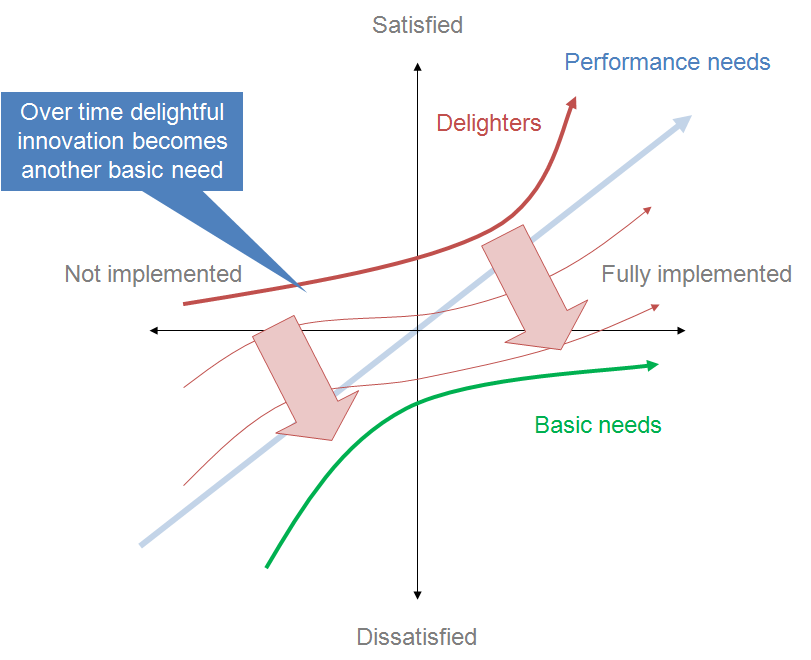
Kano Analysis: consider what is to be done using this model -
Why 3D workshops? Need to consider - play is more than just fun, it encourages critical thinking and problem solving. Play is More Than Just Fun - Stuart Brown (TED Talk 2008)

"Although we live in the age of technology, many of the places in which we learn & work are still based on industrial models developed in the early 20th Century. We have changed, our society & our community has changed. The way in which humans engage & connect with each other has changed." Andrew Ford

ULearn'15 - "FlatConnections Global Project"

Presenter: Sonya @vanschaijik
 
Abstract: "The intent of the NZ Curriculum vision (NZC 2007 p.8) is to enable connected learners who can support the well-being of New Zealand, can relate to others, participate and contribute to the world around them. This year Newmarket School students joined the FlatConnections Global project, ‘A week in the Life’. Learners were actively engaged in digital collaborative activities with 143 students and 13 teachers from 6 different countries. This project helped Newmarket School students enact the NZ Curriculum vision by enabling global connections in ways that prepared young learners for their future. Students learnt to question, investigate and act as global citizens using digital technologies and online learning environments - learning with and from students all over the world.

The students used SOLO Taxonomy as a model to to design the process of their own learning and to inquire into the impact of their actions as citizens on their communities and beyond..."


What are "Flat Connections"? Bring classes together using a range of tools to get classrooms to work together collaboratively. Primary level, up to around Year 6, there are also further projects aimed at secondary, intermediate and even ECE. Promotes student collaboration - you must be there, and actively work with the students. Very big on sharing and learning, and giving each other feedback.
Anna has just recently grouped our children into teams - 200 children and around 30 'teams'...
All about: "Connecting, Collaborating and Innovating"
Sonya's comment - "Learnt lots about citizenship and that the biggest learning is around what happens between the ears."

What is "A Week in the Life"?
We select a topical inquiry topic - then apply SOLO taxonomy
Questions to gauge audience placeent on continuum. Key ideas:
SOLO Taxonomy (i.e.: underpinned by AsTTLe)
Citizenship (i.e.: glocalization)
Global Connection (i.e.: social media)
Digital Literacy (i.e.: "Celebrate, Share, Feedback")

Activity: Participants tried out Edmodo which provides students with an interactive platform very similar to Twitter, but moderated by teacher(s)...
FlatConnections use: Fuze, Time Bridge, Edmodo, Hapara, Google Apps, Popplet, Voice Thread.
"I have, I can, I do, I am..." (links to SOLO taxonomy levels).

Reflection:
How connected are you? 
If you don't have an online presence at this point in time (teachers especially) you need to get it!
A 'digital citizenship'-linked taxonomy:
  • Your students / children certainly are, starting to talk, co-create videos (Level 1);
  • Interconnection within the school / district / nationally (Level 2);
  • Manage Global Connections (e.g: Skype, Google Hangouts);
  • Student to Student - with teacher management, global connections "across the ocean" (Level 4);
  • Student to Student - secondary school level i.e.: with student management (Level 5)
Sonya then shared what FlatConnection looked like at her Newmarket School. 
Students and Global connections - shared a history of Global Projects at Newmarket School - 
  • moved from hosting a Skype session guest Ant Sang (Bro Twown) in their class and sharing with 100 students including ones in Australia; 
  • then, the Global Assembly Project (BBC website); 
  • Health and Wellbeing, several overseas countries involved; 
  • Skype in the classroom between students overseas; 
  • Leadership in action, road patrol got involved with Travelwise schools Auckland, students became connected and collaborated; 
  • connected with a school in Nepal at the time they had a 'quake, students fundraised and sent money straight away = authentic learning; Paddlet used to co-construct and brainstorm between students...
Challenges: Synchronous Communication using Skype due to time zone differences - solution: get around this by sending video messages and leaving video messages.
Children communicate / share via Edmodo, teacher updates the Wiki, which is kept private whilst it is active, is not published as a public site until the end of the school year (for safety/privacy puposes).

Students will learn to "Connect, Collaborate and Co-Create" WHEN teachers and leaders learn to do it FIRST. As an educator, you must challenge yourself to actively collborate, and to then stretch further and further afield. 

You can effectively develop your students towards becoming 'justice-oriented' citizens; as they develop their own ideas and take on a 'glocalization' project (i.e.: a local project that has the potential to go global).

Monday, 5 October 2015

The Mindlab by Unitec: Design Thinking in Educational Leadership

Design Thinking in Education  
(Mindlab by Unitec: Week 13 - DCL) 
"Sir Ken Robinson, chair of the UK Government's report on creativity, education and the economy, described research that showed that young people lost their ability to think in "divergent or non-linear ways", a key component of creativity. Of 1,600 children agKen Robinson -  ed three to five who were tested, 98% showed they could think in divergent ways. By the time they were aged eight to 10, 32% could think divergently. When the same test was applied to 13 to 15-year-olds, only 10% could think in this way. And when the test was used with 200,000 25-year-olds, only 2% could think divergently. . . . Education is driven by the idea of one answer and this idea of divergent thinking becomes stifled.' He described creativity as the 'genetic code' of education and said it was essential for the new economic circumstances of the 21st century." signed: (TESS, 25 March 2005)
 "Why Design Thinking?" Design Thinking for educators (Vimeo video) 
* Divergent thinking is a thought process or method used to generate creative ideas by exploring many possible solutions...
"Austin's Butterfly"  building excellence in student's work (Vimeo video)
"Rose, Bud, Thorn" - 2 minute PD (video)
* Convergent thinking is focusing on a limited number of choices as possibilities. Then you choose the “right” answer or course of action from among those choices..."
 
"The Deep" (video)

Design Thinking in Leadership
(Mindlab by Unitec: Week 13 - LDC)
"This week we focussed on Leadership and Design Thinking.
As education evolves, education is working hard to keep up fostering teaching that supports an interdisciplinary approach to problem solving.
Design Thinking is a hands-on problem finding and solving session that provides a forum for experiential learning. We apply Design Thinking methods such as posing short explorative questions that launch brainstorms. This builds a platform broad enough to uncover a wide range of solutions. We then learn to shape options that are sufficiently narrow to work through the problems using rapid prototyping techniques.
As a result, we are able to flesh out a number of needs that are both meaningful and actionable. Like designers, we will create simple three-dimensional models to get our ideas across."

Ewan McIntosh on Design Thinking for Librarians' and Teachers' professional development.

Thursday, 10 September 2015

Mindlab by Unitec: Group Collaboration

An unscripted video collaboration with Michelle and Desire' 
as part of my practicum tutorial work during the first half 
of my Mindlab PGCert in Applied Practise...

International Perspectives on Education and Assessment

How Culturally Intelligent are we? "Cultural Intelligence (CQ) is a person's ability to function effectively in situations characterized by cultural diversity" (Ang, Van Dyne & Koh, 2005; Earley & Ang, 2003; Earley & Mosakowski, 2005).


PISA - Measuring student success around the world

International Perspectives on Education LDC / Assessment DCL Week 9
Case Study: Finland (quiz hosted by our tutor Milla). We played an interactive quiz created in Kahoot! which encouraged us to competitively test our prior knowledge about Finland (I was even coming third til my browser crashed... and Janet came 2nd overall, just behind Dr Dave who'd prepped for the test from the previous session)...

Group Activity
What does assessment heaven vs.hell look like? Our thoughts:

Collaborative Activity 
We had been set a collaborative assignment - to select one key item that ensures strong outcomes for our learners when looking at the research out there. Desire', Michelle and I looked at the commonalities between Canada, Singapore and Canada. We decided that treating teachers as valued professional in a society was what made the most consistent positive effect for these nations when ranking them on the PISA scale. Here's the video Michelle, Desire' and I created to show what the news might look like in the year 2020 were this to become the case in NZ, too...

*Newsflash 2020*

Research Tips
Go into your Moodle portal - go to your dashboard, stack of books bottom left, click on these, will open up Unitec Library screen - automatically logs you in from there...

Thursday, 3 September 2015

School Transformation and Leadership in Digital & Collaborative Learning

School Transformation Week 8 - DCL

Recommended viewing:

Ask the “Why” Question - video by Claire Boonstra

3 Rules to spark learning - Ramsey Musallam TED video 

 An Open Letter to Educators - Dan Brown

Innovative Learning - Rothaugen School

Changing Education paradigms - RSA Animates

Recommended website: 
The Transformation of Education

Leadership in Digital & Collaborative Learning Week 8 - LDC

Addendum: When creating work online for the purposes of teaching at a given school, all of the work you produce in the course of your teaching contract is currently legally owned by your most current BoT, under current NZ law in regards to Creative Commons. To ensure your legal ownership of your own intellectual property, you will need to go to your principal (as representative of the BoT) to request confirmation in writing that you are allowed to use your online intellectual property (i.e.: planning, resources, professional blog, you tube clips, anything shared while you have been working with the students) yourself.